AI Receptionist for Clinics in Ontario: A PHIPA-Ready Checklist
Key takeaways
- The clinic is the health information custodian under PHIPA; an AI vendor acts on its behalf, and the clinic remains accountable.
- AI appointment booking only works well when it integrates directly with your EMR or practice-management system.
- Design patient intake automation to collect the minimum needed before a visit, and never let the assistant give medical advice.
- The Ontario privacy commissioner's January 2026 guidance on AI scribes is a useful blueprint for governing any AI tool in a clinic.
Clinic phones ring hardest when staff are busiest, and every unanswered call is a patient who may book elsewhere. An AI receptionist can absorb the routine load. In healthcare, though, the privacy rules are stricter and the cost of a wrong answer is higher. This checklist covers both.
What an AI receptionist actually does
A well-scoped clinic assistant handles the repetitive work:
- Answers questions about hours, location, parking, services and fees
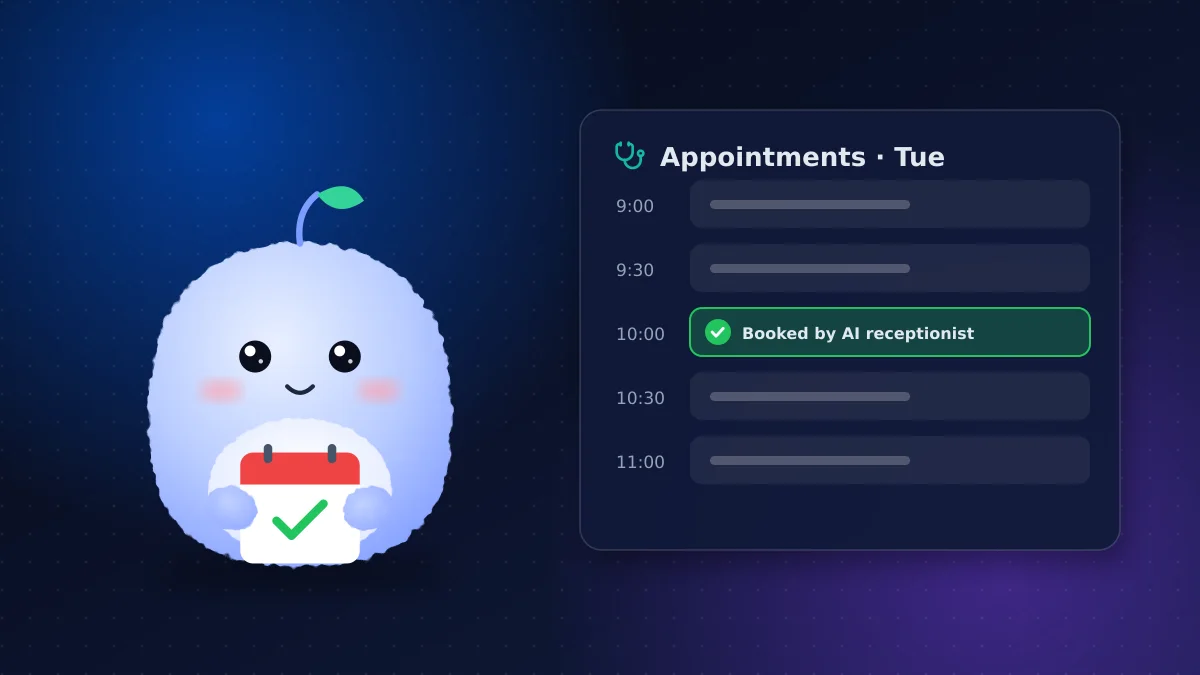
- Books, reschedules and cancels appointments
- Collects pre-visit intake details and insurance information
- Sends reminders and confirmations
- Works after hours and on weekends
- Routes clinical questions and urgent issues to staff, or directs emergencies to 911
It is not a triage nurse. The assistant should never interpret symptoms or suggest treatment.
Phone, chat or both?
Most clinics start with whichever channel overflows first. A website chat assistant is quicker to launch and handles the many patients who would rather book online. A voice assistant answers the phone itself, which matters for older patients and after-hours calls, but needs more careful testing for accents, background noise and urgent requests. Both can share the same knowledge base and booking integration.
Where PHIPA comes in
Ontario's Personal Health Information Protection Act treats your clinic as a health information custodian. Any vendor that handles personal health information for you acts on your behalf, and you remain accountable for it.
In practice that means:
- A written agreement with the vendor that limits how data is used
- Reasonable safeguards: encryption, access controls and audit logs
- Collecting, using and disclosing only what is necessary
- Notifying affected patients and the Information and Privacy Commissioner of Ontario when required after a breach
Clinics in other provinces have equivalents. Calgary clinics work under Alberta's Health Information Act, and private clinics in Vancouver are generally covered by BC's Personal Information Protection Act.
Patient intake automation without over-collecting
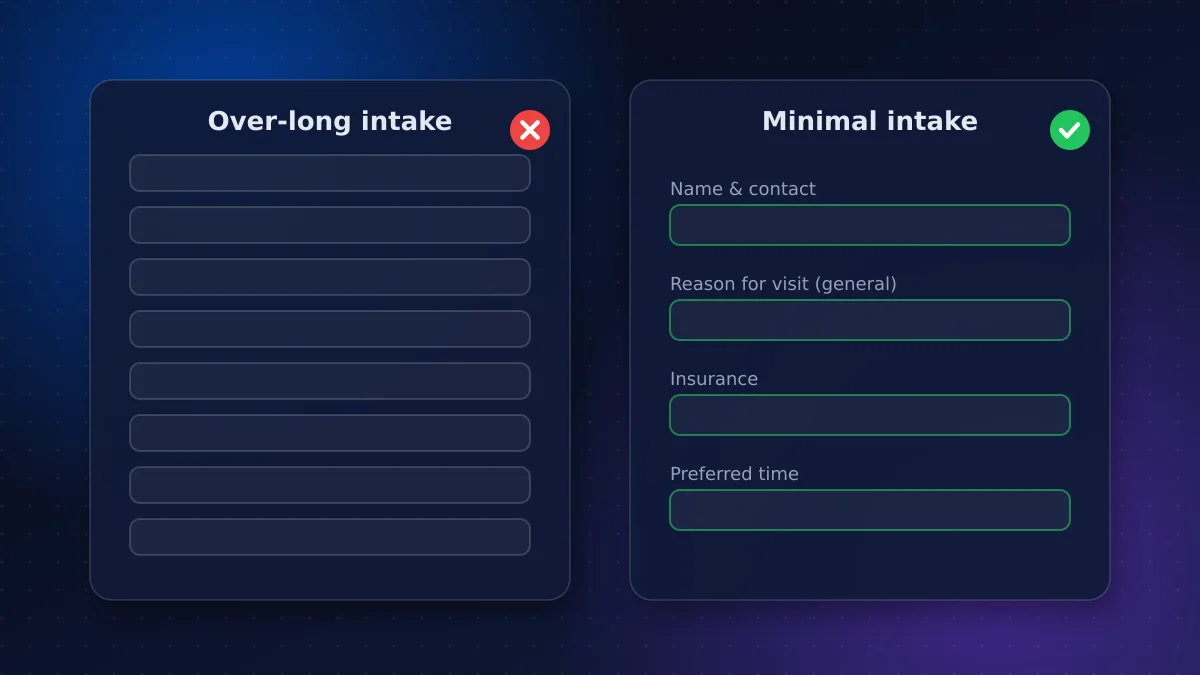
Patient intake automation saves front-desk time, but every extra field is more personal health information to protect. Collect what the visit needs, such as contact details, reason for visit at a general level, and insurance, and leave detailed medical history for the secure clinical system or the appointment itself.
AI appointment booking: integration matters most
AI appointment booking is only as good as its connection to your schedule. An assistant that takes a request and emails it to staff saves little. One that reads real availability and writes bookings into your EMR or practice-management system saves hours every week.
Before choosing a vendor, confirm it supports your system, whether that is an EMR common in Ontario family practice or a scheduling platform used by physio, chiropractic and dental clinics. If it doesn't integrate, budget for custom work. Our page on AI for healthcare practices covers what that integration involves.
Lessons from Ontario's AI scribes guidance
In January 2026 the Information and Privacy Commissioner of Ontario published guidance on AI scribes, the tools that transcribe and summarize patient visits. A receptionist is a different tool, but the principles carry over:
- Set up governance: someone accountable for each AI system
- Assess privacy risks before launch, including a privacy impact assessment where appropriate
- Apply strong security safeguards and monitor the system over time
- Be transparent with patients about how AI is used
Building to this standard now is the simplest way to stay ahead of what regulators expect.
Notes for dental clinics and allied health
Dental clinics, physiotherapy and other allied health practices often see the fastest payback, because so much of their volume is booking and rebooking. Check your regulatory college's standards on advertising and patient communication too. The assistant's wording on fees, services and outcomes needs the same care as your website.
Vendor checklist: questions to ask
- Where is patient data stored and processed, and can it stay in Canada?
- Is our data used to train your models? (The answer should be no.)
- Which subprocessors handle our data?
- Is data encrypted in transit and at rest?
- Do we get audit logs of every conversation?
- How long are transcripts kept, and can we set retention?
- Will you sign an agreement that reflects our PHIPA obligations?
- How does the assistant hand off urgent or clinical questions?
- How do you test answers for accuracy before launch?
- What is your breach notification process?
Rolling it out safely
Start narrow. Launch with FAQs and booking, review every transcript for the first few weeks, then add intake and reminders once answers are reliable. Most clinics are better served by a phased AI agent build than by switching everything on at once.
Bringing your front-desk team along
Staff support decides whether an AI receptionist succeeds. Involve your front-desk team in writing the answers and handoff rules, since they know the questions patients actually ask. Make clear the goal is to remove repetitive calls, not jobs, and give them an easy way to flag wrong answers so content gets fixed the same day.
Measuring whether it's working
Track a handful of numbers from the first week:
- Answered rate: the share of calls and chats handled without a missed contact
- Bookings captured after hours that would otherwise have been lost
- Handoff rate: how often the assistant escalates to staff, and why
- Accuracy: errors found in transcript reviews, trending down over time
- Front-desk time saved, measured as hours staff spend on the phone
If the handoff rate stays high for a particular question, fix the content behind it rather than the AI.
Conclusion: automate the routine, protect the patient
An AI receptionist for clinics in Ontario can return hours to your front desk and capture bookings you currently miss, provided it is built around PHIPA from the start: minimal collection, a vendor you can hold accountable, and clear handoffs to people. This is a practical guide, not legal advice; confirm specifics with your privacy officer or counsel.
If you're considering an assistant for your clinic, tell us about your practice and we'll outline a PHIPA-conscious setup that integrates with the systems you already use.
Frequently asked questions
Can an AI receptionist be PHIPA compliant?
Yes, if it is set up properly. The clinic remains the health information custodian, so it needs a written agreement with the vendor, strong safeguards such as encryption and audit logs, minimal data collection and a breach response plan.
Can an AI receptionist book appointments directly into our EMR?
Many can, through integrations or APIs with common EMR and practice-management systems. Confirm support for your specific system before choosing a vendor, or budget for a custom integration.
What happens if a patient describes an emergency to the AI receptionist?
A well-designed assistant recognizes urgent language and immediately directs the patient to call 911 or reach staff. It should never attempt to assess symptoms or give medical advice.
Does patient data from an AI receptionist have to stay in Canada?
PHIPA does not contain a blanket Canada-only storage rule, but the clinic must protect the data and remains accountable for it. Many Ontario clinics require Canadian hosting as a matter of policy, so ask vendors where data is stored and processed.
Vaibhav Malhotra
Founder, VMR Technologies
Vaibhav Malhotra is the founder of VMR Technologies, where he leads the team building custom websites, e-commerce platforms, and AI solutions for businesses across the Greater Toronto Area and beyond. He writes about practical software and AI strategy for non-technical decision-makers — focused on what actually drives results rather than hype.