How to Choose a Web Development Company in Canada: A 2026 Checklist
Key takeaways
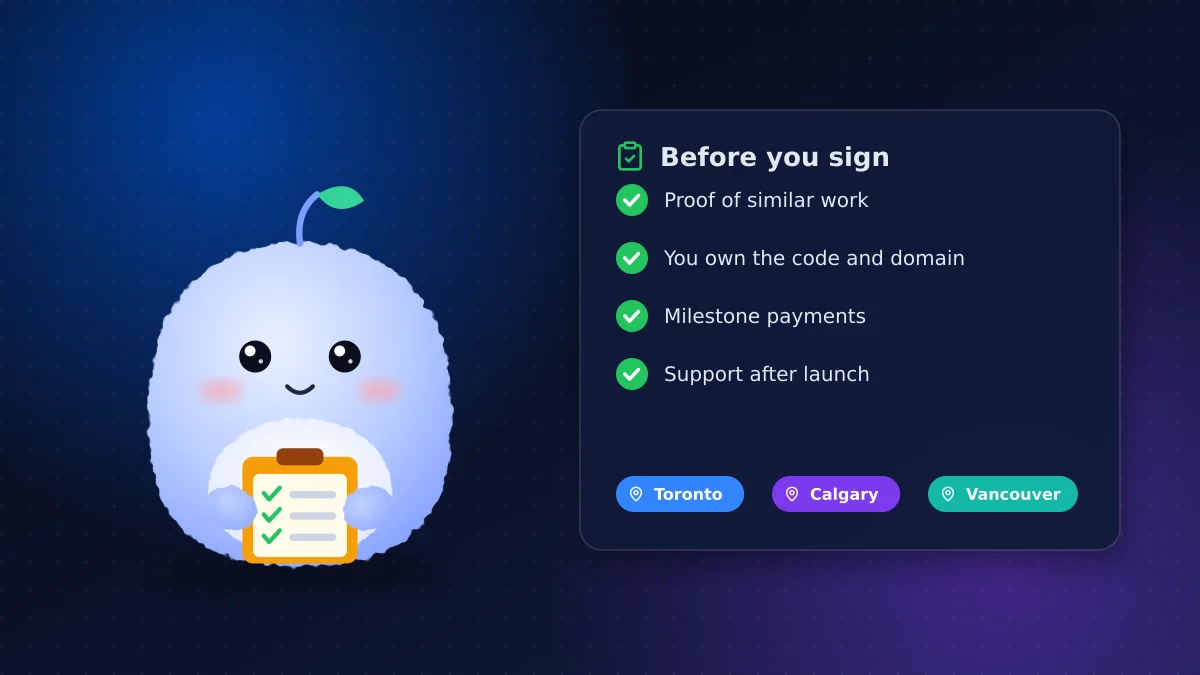
- Judge proof before price: ask for similar projects, live links and references you can actually call.
- Make sure your business owns the domain, hosting account, code repository and design files, in writing.
- A good website development contract ties payments to milestones and defines change requests, acceptance and handover.
- Remote projects across Canada work well with a clear meeting rhythm; the GST/HST rate follows the client's province.
Most bad website projects are predictable. The warning signs show up in the sales conversation, if you know what to ask. This checklist is what we would want a friend to use before hiring any developer, including us.
Start with the outcome, not the technology
Before you talk to anyone, write down what the website must achieve: more qualified enquiries, online bookings, e-commerce revenue, or a credible presence for investors. A competent developer will ask about this first. If the first conversation is about frameworks and page counts rather than your customers, that tells you how the project will be run.
Proof: portfolio, references and results
Ask for two or three projects close to yours in size and industry, with live links. Then check them yourself on your phone. Are they fast? Can you find the contact form in two taps? Do they still exist?
References matter more than polished case studies. Ask a past client three things: did the project finish on time and on budget, how were problems handled, and would they hire the team again? You can see our own recent projects as an example of what to look for.
Who owns the website code, domain and accounts?
This is the most common source of disputes we hear about, and it is easy to prevent. Before you sign, confirm in writing that your business will own or control:
- The domain name, registered in your company's name and email
- The hosting account, or a documented way to transfer it
- The code repository, with admin access for you
- CMS admin logins with the highest permission level
- Design files, fonts and any purchased licences
- Analytics, Search Console and ad accounts
Asking who owns the website code is not rude; it is basic due diligence. A developer who resists giving you ownership is building leverage, not a website.
What a website development contract should cover
A one-page quote is not a contract. A solid website development contract includes:
- Scope: pages, features and integrations, plus what is excluded
- Milestones and payments: deposits tied to deliverables, not dates
- Change requests: how new ideas are priced and approved
- Acceptance: how you sign off each stage
- Warranty: a bug-fix period after launch
- IP assignment: ownership transfers on payment
- Termination and handover: what you receive if either side walks away
Freelancer vs agency: an honest comparison
Neither is automatically better. The right choice depends on the size of the project and how much risk you can carry.
| Factor | Freelancer | Agency |
|---|---|---|
| Cost | Usually lower | Usually higher |
| Capacity | One person's hours | A team: design, development, QA |
| Continuity | At risk if they get busy or move on | Shared knowledge across the team |
| Best for | Small, well-defined sites | Integrations, deadlines, ongoing growth |
The freelancer vs agency question often comes down to continuity. If your site will need regular changes for years, choose a setup that survives one person's vacation.
How to hire a web developer remotely across Canada
You don't have to hire in your own city. Discovery workshops, design reviews, demos and sign-offs all work well over video. To hire a web developer remotely without friction:
- Agree on a meeting rhythm. A weekly 30-minute call plus a shared project board works better than ad hoc email.
- Mind the time zones. Vancouver is three hours behind Toronto and Calgary is two, so book calls in the overlap.
- Understand the tax. Under the CRA's place-of-supply rules, GST/HST generally follows the client's province. An Ontario firm charges a client in Ottawa 13% HST, but a client in Calgary only 5% GST. BC charges PST separately, so check it with your accountant.
What a well-run project looks like
A professional process is visible from the first week. Expect roughly this sequence, whatever the size of the project:
- Discovery: goals, audience, competitors and the content you already have
- Sitemap and wireframes: the structure agreed before any design polish
- Design: one or two key pages approved before the rest are built
- Build and content: pages assembled, forms and integrations connected
- QA: testing on real phones, accessibility checks and speed tuning
- Launch and handover: redirects from old URLs, analytics, and training for your team
If a developer jumps straight to design without discovery, the questions they skipped will surface later as change requests.
Support after launch
A website is never finished at launch. Ask what a support plan covers: security updates, backups, uptime monitoring, small content changes and response times. A monthly retainer suits businesses that update often; a bank of hours suits those that don't. Either way, get it in writing before the project ends, not when something breaks.
Questions to ask a web developer before you sign
- Who exactly will work on my project, and who is my day-to-day contact?
- Can I speak with two recent clients?
- What is included in the price, and what would cost extra?
- How do you handle change requests mid-project?
- Who owns the code, domain and accounts at the end?
- What happens after launch: warranty, support plans and response times?
- How will you measure whether the site is working?
- What do you need from us, and by when?
Good developers like these questions. Vague answers to the questions to ask a web developer above are your signal to keep looking.
Red flags to walk away from
- A quote with no written scope, or a price that seems far too low
- Pressure to pay the full amount up front
- No live examples, or examples you can't verify
- Hosting or domains held only in the developer's name
- No plan for after launch
Conclusion: choose the partner, not the pitch
The best web development company for you is the one that understands your customers, shows verifiable proof and puts ownership and scope in writing. Price matters, but a cheap project that has to be rebuilt in a year is the most expensive option there is. For a sense of budgets, see our guide to custom website costs in 2026.
If you're comparing developers now, send us your project brief. We'll reply with a written scope, a fixed-price estimate and answers to every question on this list.
Frequently asked questions
Should a small business hire a freelancer or an agency?
Hire a freelancer for a small, well-defined site with a modest budget. Choose an agency when you need design, development and QA together, integrations, a firm deadline, or ongoing changes over several years, because a team gives you continuity.
Who should own my website's domain and code?
Your business should. Register the domain in your company's name, hold admin access to the hosting account, code repository and CMS, and make sure the contract assigns intellectual property to you on payment.
Can a web developer in the GTA work with a business in Vancouver or Calgary?
Yes. Remote web projects are routine. A weekly video call, a shared project board and meetings scheduled in the overlap between time zones keep them on track, and design reviews work just as well on screen.
What sales tax does an Ontario web developer charge clients in other provinces?
GST/HST generally follows the client's province under CRA place-of-supply rules: 13% HST for Ontario clients and 5% GST for Alberta clients. British Columbia also has a separate PST, so confirm your situation with an accountant.
Vaibhav Malhotra
Founder, VMR Technologies
Vaibhav Malhotra is the founder of VMR Technologies, where he leads the team building custom websites, e-commerce platforms, and AI solutions for businesses across the Greater Toronto Area and beyond. He writes about practical software and AI strategy for non-technical decision-makers — focused on what actually drives results rather than hype.