SR&ED for Software Development: What Qualifies and How to Claim
Key takeaways
- Eligible work resolves technological uncertainty that standard practice can't answer, through a systematic investigation.
- Routine development, such as building features with known frameworks, UI work and bug fixing, generally doesn't qualify.
- Eligible CCPCs can earn a 35% refundable credit up to their expenditure limit; other claims generally earn 15%.
- Arm's-length contractor payments generally count at 80%, and only one party can claim the same work.
- File Form T661 within 18 months of your tax year-end, backed by records made during the work.
SR&ED, Canada's Scientific Research and Experimental Development program, is one of the largest sources of government support for software companies. It's also widely misunderstood. Some teams claim routine work and get reassessed; others never claim genuine experimental work because they assume it's only for labs. This guide covers both mistakes. It isn't tax advice, so work with an SR&ED specialist or accountant on your claim.
What SR&ED rewards
The Canada Revenue Agency looks for three things in eligible work:
- Technological uncertainty: you couldn't know whether, or how, you could achieve the result using standard practice and publicly available knowledge
- A systematic investigation: you formed hypotheses, tested them through experiment or analysis, and drew conclusions
- Technological advancement: the work generated new knowledge, even if the project itself failed
The CRA's SR&ED program pages set out the policies in detail.
What qualifies in software development
Technological uncertainty in software usually shows up as a problem experienced developers couldn't solve with known techniques:
- Designing an algorithm to meet performance limits that existing approaches couldn't reach
- Making systems interoperate when there was no known way to do it reliably
- Building a data pipeline that had to handle volumes or latency beyond standard architectures
- Developing new methods for a machine learning problem where established models failed
What usually doesn't qualify
Much valuable software work is not SR&ED:
- Building features with established frameworks and known patterns
- User interface and visual design
- Routine bug fixing and testing
- Configuring off-the-shelf platforms, themes or plugins
- Data entry, content work and standard integrations with documented APIs
That's why a typical business website or Shopify store doesn't qualify, even when it's complex.
Machine learning projects: where the line falls
Machine learning projects attract SR&ED attention because they look experimental. The CRA's position, echoed by SR&ED specialists, is that training a model with well-established methods on your data is generally not enough. Work may qualify when standard approaches demonstrably failed and your team had to develop new techniques, architectures or data-handling methods to resolve the uncertainty. Document the failed attempts; they are often the strongest evidence.
Examples: eligible or not?
| Work | Likely SR&ED? | Why |
|---|---|---|
| Building a booking site with a standard framework | No | Known techniques, no technological uncertainty |
| Integrating a CRM through its documented API | No | Routine integration |
| Developing a new matching algorithm after existing approaches failed to meet latency targets | Possibly | Systematic experimentation to resolve uncertainty |
| Training a classifier with standard methods on labelled data | Usually no | Established practice |
| Creating a new method to train models on sparse, noisy sensor data when standard techniques failed | Possibly | New knowledge beyond standard practice |
These examples are simplified; eligibility always depends on the specific uncertainty and how the work was carried out.
How the credit is calculated
| Claimant | Federal credit | Notes |
|---|---|---|
| Eligible CCPC, up to its expenditure limit | 35%, refundable | Budget 2025 proposed raising the limit to $6 million |
| Most other claims | 15%, generally non-refundable | Can offset tax payable |
Provinces add their own programs on top, such as Ontario's innovation tax credit, so the combined benefit can be higher.
The proxy method for overhead
Instead of tracking overhead in detail, most software companies use the proxy method. It adds a prescribed proxy amount of up to 55% of eligible SR&ED salaries to cover overhead. It's simpler and usually better suited to software teams than the traditional method.
Contract payments: working with a development partner
If you hire an outside developer at arm's length to do eligible work on your behalf, contract payments generally count at 80% of the amount paid. Only one party can claim the same work, so your contract should say who claims SR&ED. Usually that's the business that bears the financial risk and owns the results.
If you plan to claim, tell your development partner before the work starts so you can keep the records you'll need.
Records that make or break a claim
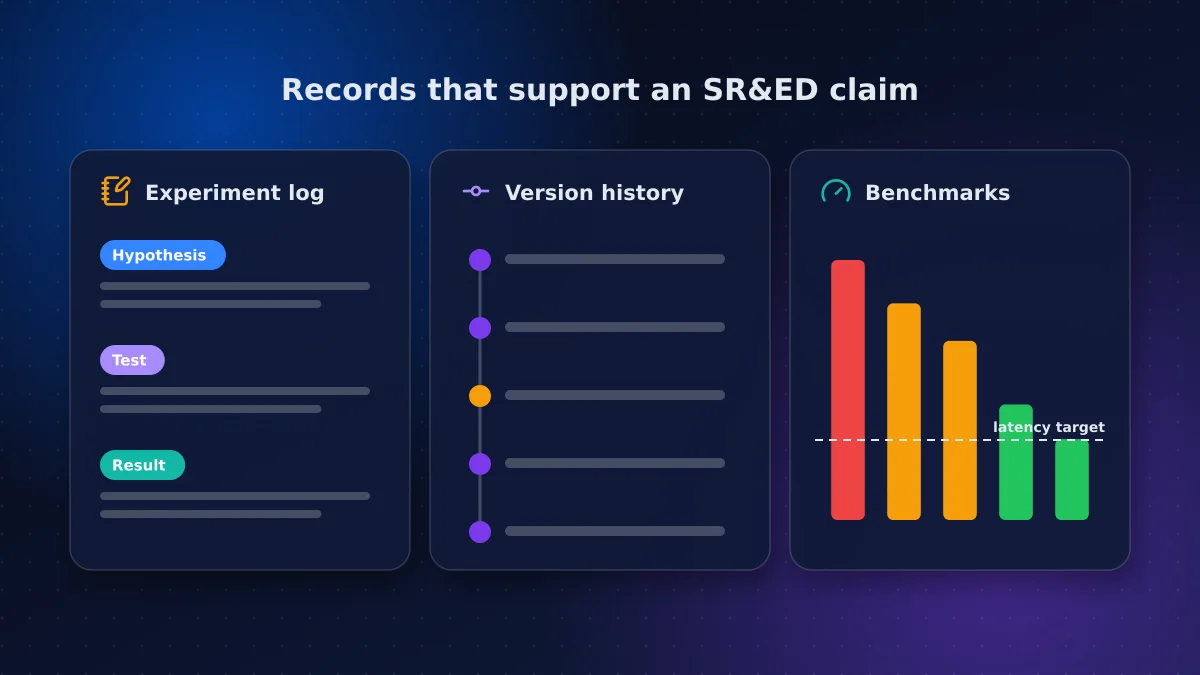
The CRA expects evidence created during the work, not reconstructed afterwards:
- Project plans that state the technical uncertainties
- Experiment logs, test results and benchmarks
- Version control history and issue tracker records
- Notes on approaches tried and why they failed
- Timesheets linking people to SR&ED activities
Common claim mistakes
- Claiming whole projects instead of the experimental portion
- Describing business goals ("launch a new product") instead of technical uncertainties
- Reconstructing records months later instead of documenting during the work
- Claiming contractor work the contractor is also claiming
- Missing the filing deadline for a year with eligible work
Working with an SR&ED specialist
Many companies use an SR&ED consultant or accountant to prepare claims. Ask how they assess eligibility, how they'll interview your technical team and what records they need. Fee arrangements vary between fixed fees and contingency fees, and Form T661 requires you to disclose who prepared the claim and how they are paid. A good advisor will tell you when work doesn't qualify, which protects you in a review.
Deadlines and the T661 form
Claims are filed with Form T661 alongside your corporate tax return. The hard deadline is 18 months after your tax year-end; miss it and the credit for that year is lost. Budget 2025 also proposed an optional pre-claim approval process, so ask your advisor whether it makes sense for larger claims.
Conclusion: claim the experiments, not the routine
SR&ED for software development rewards genuine experimentation: problems without a known solution, tackled systematically and documented as you go. Separate that work from routine development, keep the records, and file on time.
For the wider funding picture, see our guide to funding after CDAP. If you're planning an AI or machine learning project with real technical risk, talk to us about scoping it so the experimental work is clearly defined and documented from day one.
Frequently asked questions
Does software development qualify for SR&ED?
Some does. Work qualifies when it resolves technological uncertainty that standard practice couldn't answer, through systematic experimentation. Routine feature development, UI design and bug fixing generally don't qualify.
Can I claim SR&ED if I hire an outside developer?
Generally yes, if the work is eligible and the developer is at arm's length. Contract payments usually count at 80%, and only one party can claim the same work, so state in the contract who will claim.
What is the deadline to file an SR&ED claim?
Form T661 must be filed within 18 months of the end of the tax year in which the expenditures were incurred. Late claims for that year are not accepted.
Does training a machine learning model qualify for SR&ED?
Training a model with well-established methods generally doesn't. It may qualify when standard approaches failed and your team had to develop new techniques to resolve the uncertainty, documented as the work happened.
Vaibhav Malhotra
Founder, VMR Technologies
Vaibhav Malhotra is the founder of VMR Technologies, where he leads the team building custom websites, e-commerce platforms, and AI solutions for businesses across the Greater Toronto Area and beyond. He writes about practical software and AI strategy for non-technical decision-makers — focused on what actually drives results rather than hype.